
REGILIENCE+ Climate Adaptation resources
REGILIENCE+ is producing 150 Adaptation Solutions and knowledge products to bolster regional climate resilience. This practitioner-focused toolkit features EU-funded solutions adapted to specific regional needs. We work closely with platforms like the Mission Portal, Climate-ADAPT, and ClimateScan, among other platforms to prevent overlap and guide our visitors toward existing platforms that offer comprehensive tools for climate risk management.
Introduction
Your Gateway to Climate Adaptation!
The REGILIENCE+ Resources section is designed to help you find solutions for a more climate-resilient future. Whether you are a local or regional policymaker, a community leader, or an organisation dedicated to climate action, this section has easy-to-use tools and information to support your adaptation journey.
What can you find in the REGILIENCE+ Resources?
Step-by-step guides, briefing materials, and quick hazard guides that explain how to anticipate climate risks and build long-term resilience strategies.
The REGILIENCE+ resources is organised to make your experience smooth and intuitive. You can explore the content by selecting specific climate hazards, or by Regional Adaptation Support Tool (RAST)
- Infographics and factsheets: concise, structured materials that help navigate the R+ solutions.
- Quick Guides: Designed to be practical and accessible, each guide focuses on a specific hazard,
breaking down complex challenges into concise, engaging formats - Video Interviews: Short recorded interviews that showcase the implementation of concrete
adaptation solutions in European regions. They feature local actors explaining the challenges
they faced, the steps and actions taken and the outcomes observed, without diving deeply into
technical aspects. Materials will include subtitles if they are prioritised. - Slide decks: structured materials developed to support capacity building across regions. They
cover selected key climate risks and present solutions from the inventory in a sequence learning
format.
- Case Studies: A real-world, localized story of an adaptation measure that has actually been planned or implemented on the ground in Europe. They showcase good practices, demonstrate feasibility, and inspire replication in other regions by sharing practical lessons learned. It includes concrete details about a specific geography, detailing the exact local climate challenge, the approach taken, stakeholder engagement, the actual costs and funding sources, the timeline, and the real barriers encountered by local decision-makers.
- Tools: An interactive or methodological instrument (like software, a calculator, a comprehensive guideline, or an analytical framework) designed to help users actively perform an adaptation tas.
- Adaptation Option: A conceptual measure or strategy designed to address a specific climate vulnerability or risk. It give users inspiration and a structured overview of potential actions per sector. It explores the theoretical benefits, costs, implementation barriers, and co-benefits of an idea.
Regional Adaptation Support Tool (RAST) steps
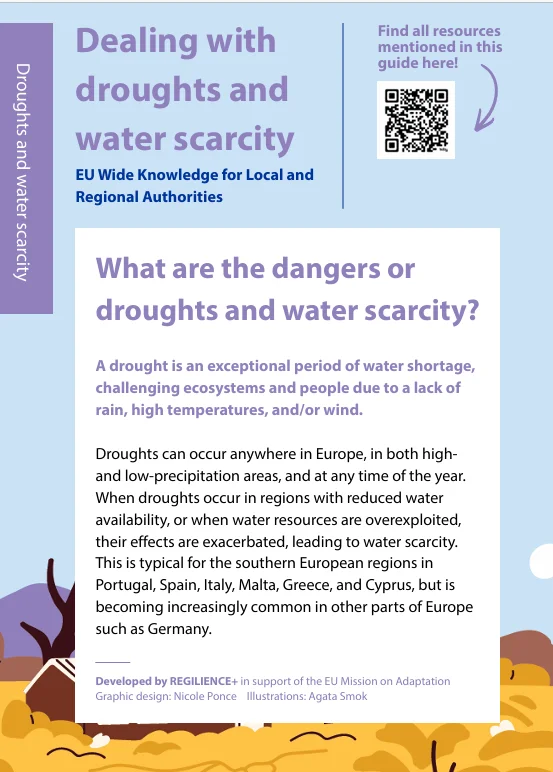
Dealing with Droughts and Water Scarcity
Neque porro quisquam est qui dolorem ipsum quia dolor sit amet

Dealing with River Floods
Neque porro quisquam est qui dolorem ipsum quia dolor sit amet

Dealing with Flash Floods
Neque porro quisquam est qui dolorem ipsum quia dolor sit amet

Digital Transformation in Water Management boosts climate resilience in the Puglia region, Italy
Best practices and innovative technologies adopted by Puglia’s water operator help preserve water resources

Increasing Protected Area Resilience in Northern Sweden
Protected area adaptation in Sweden is part of a cross-border project, which also includes Norway and Finland. National parks are improving resilience towards several climate challenges alongside mitigation efforts and piloting climate-smart solution

Promoting climate resilience in the agricultural sector with native seeds and better-adapted crops in Navarre, Spain
Navarre is proactively preserving vegetable varieties and showcasing the best-adapted cereals and other crops to each agricultural climate in the region.